Written by Ertian Jiang(Jasper), Haosen Jewelry Manufacturer’s founder with 16+ years in fashion jewelry manufacturing. This guide combines technical rigor with practical B2B sourcing insights.
In the competitive global jewelry market, Acero inoxidable 316L has emerged as the industry standard for high-performance, hypoallergenic, and durable jewelry. As a specialized 316L stainless steel jewelry manufacturer, we ensure all products are 100% REACH & RoHS compliant (including EU Directive 2015/863). You can view our certified testing standards and SGS reports here, making 316L the premier choice for durable, high-quality fashion jewelry.
What is 316L Stainless Steel ?
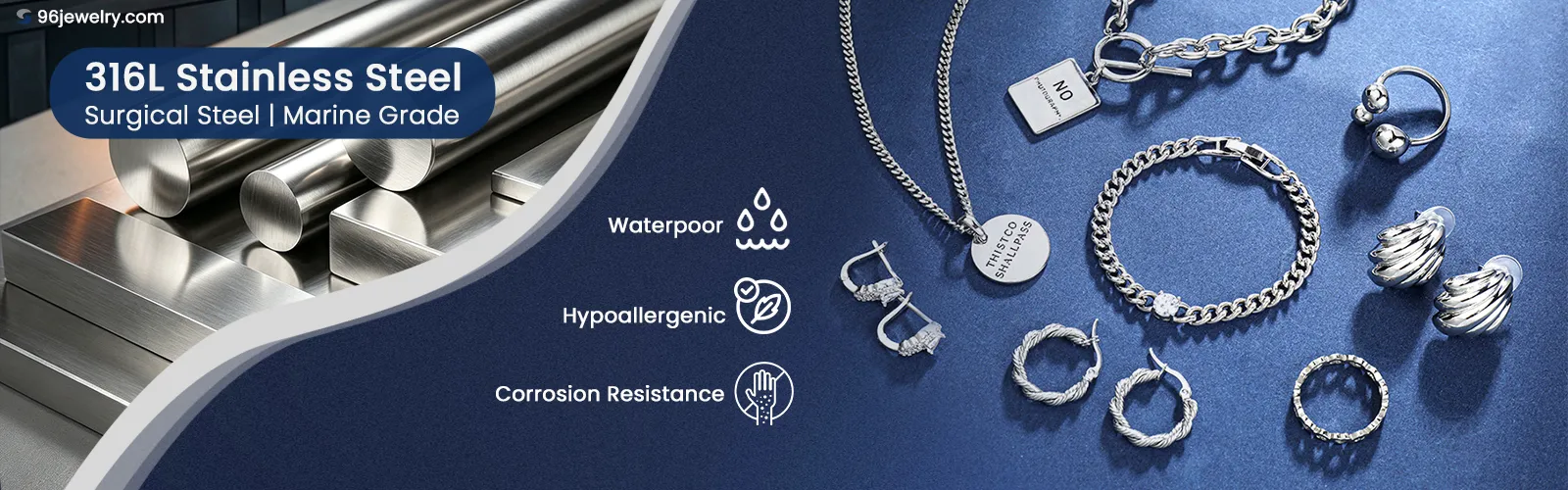
316L stainless steel jewelry is a low-carbon, 316 molybdenum-bearing austenitic stainless steel designed for corrosion resistance, hypoallergenic wear, and long-term durability in fashion jewelry manufacturing.
With a carbon content restricted to 0.03%, it is specifically engineered to prevent sensitization (carbide precipitation) during manufacturing, ensuring the metal maintains its structural integrity and corrosion resistance. In the North American market, it is frequently referred to as “Surgical Steel” or “Marine Grade” due to its high-purity composition.
The superior performance of 316L in jewelry applications is driven by its unique chemical profile :
- Molybdenum (Mo) Enhancement: The inclusion of molybdenum provides exceptional resistance to pitting and crevice corrosion in chloride environments, such as sweat and salt water.
- Corrosion Resistance: It is virtually immune to tarnishing and oxidation, ensuring the jewelry retains its original luster even with daily wear.
- Hypoallergenic Properties: As a medical-grade material, 316L is safe for sensitive skin and is the primary choice for body-piercing jewelryand medical implants.
- Structural Durability: It is significantly harder than silver or gold, offering superior scratch resistance and ensuring that designs maintain their precise geometry over time.
Need professional 316L jewelry sourcing support?
Click here to get your custom quote within 24 hours.
8 Forms of 316L Stainless Steel & Their Jewelry Applications
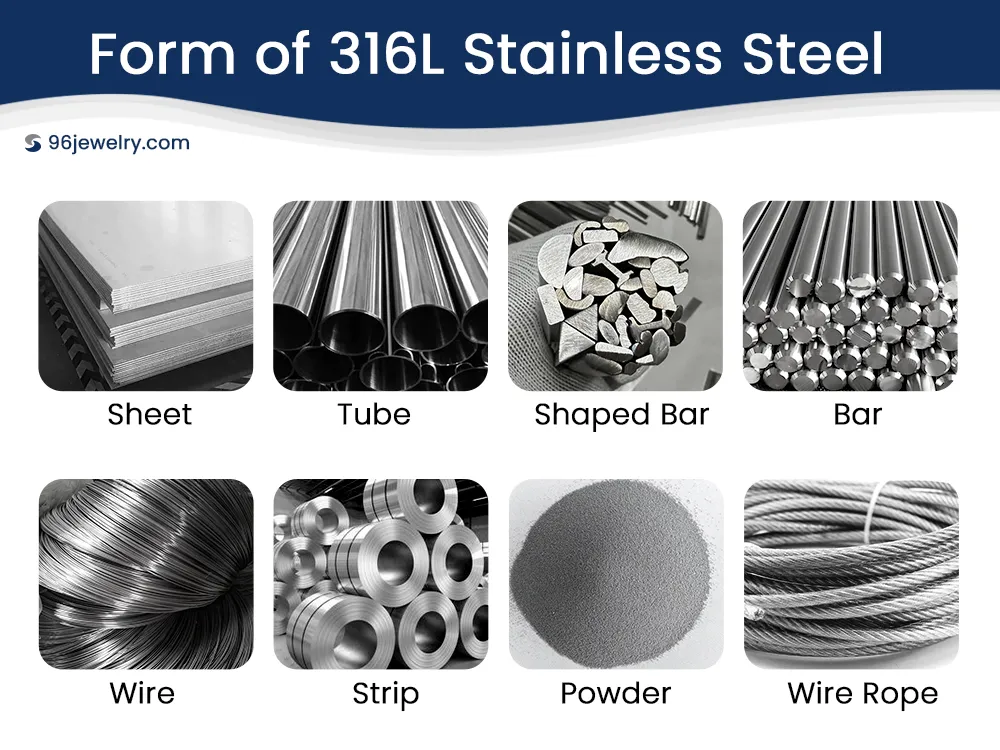
Before the manufacturing process begins, selecting the correct material form is vital for optimizing yield rates and achieving the desired design aesthetic. Our facility sources 316L in various specialized formats to support diverse jewelry categories, from high-precision CNC rings to complex 3D-printed components.

View the Haosen Stainless Steel Collection.
| Form Category | Applicable Jewelry Types | Common Types & Description | Typical Standards/Specifications | Applicable Equipment |
|---|---|---|---|---|
| Sheet/Plate | All types of jewelry | By thickness: Thin sheet (0.2-4.0mm), Medium plate (4-20mm) – thicker not used in jewelry; By surface/finish: Mirror (8K), Brushed (HL); By supply form: Coil, Flat sheet | ASTM A240; AMS 5524/5507 | Cross-cutting equipment (uncoiling, leveling, cross-cutting); Bending machine; Rolling equipment; Laser cutting machine; Stamping press; Brushing/Polishing machine |
| Tube/Pipe | Bracelets, some rings, hollow accessories | By process: Seamless tube, Welded tube; By cross-section: Round, Square, Rectangular, Oval, Hexagonal, etc. | Seamless tube: Φ6~1220×1~50mm; Square tube: Φ20~300×1~8mm; Capillary tube: Φ0.4~6×0.03~1mm | Laser tube cutting machine; CNC machining |
| Profile (Shaped Bar) | Watchbands, bracelets, accessory production | Custom profiles: Various special cross-sections made to customer drawings | ASTM A276; JIS G4303 | Stretch bending machine; Laser tube cutting (also for angle steel, channel steel); CNC automatic cutting machine (punching, slotting, cutting); Milling/slotting machine |
| Bar/Rod | Rings, bracelets | By cross-section: Round bar, Square bar, Hexagonal bar, Flat bar; By surface: Black bar (rough turned), Bright bar, Ground bar, Turned bar | Diameter: Φ4mm – 120mm; Length: 2 – 6 meters | CNC lathe / mill-turn machining center; Grinding machine (OD/ID precision grinding); Polishing/brushing machine |
| Wire | Necklace chains, wire earrings, ear posts | By use: Screw wire, Spring wire; By surface/finish: Bright wire, Electrolytic wire, Cold drawn wire; By supply form: Straight length, Coil | Diameter: Φ1.5 – 25mm | Straightening & cutting machine; Surface grinding/polishing machine; Chain weaving machine |
| Strip/Coil | Jewelry with thickness ≤2mm | Strip: Thin material supplied in coil form (steel strip) | ASTM A240 | Automatic progressive stamping; Continuous roll forming |
| Powder (Atomized) | All types of jewelry (except elastic items) | For: 3D printing, Metal Injection Molding (MIM), powder metallurgy sintered parts; Characteristics: Typically spherical, particle size from nano to micron | ASTM B212 | Ultrasonic atomizer / atomization equipment (for 316L powder production); Selective Laser Melting (SLM) 3D printer; Binder Jetting (BJ) additive manufacturing equipment |
| Wire Rope/Strand | Elastic bracelets | Constructed by twisting multiple strands of wire; used where high strength and flexibility are required | ASTM A492-95 | CNC cutting machine |
Not all fashion jewelry designs can use a specific stainless steel raw material form. Material selection depends on structure, thickness, strength requirements, surface finish, production method, and cost efficiency.
We evaluate each product design based on functionality, manufacturing feasibility, and performance standards, and then select the most suitable stainless steel form to ensure optimal quality, stability, and production efficiency.
With diversified raw material inventory and integrated processing capability, we help you move from drawing to finished product efficiently — while maintaining cost control and flexible MOQs starting at 30 units.
If you are developing a new jewelry collection and are unsure which stainless steel form is most suitable, contact our engineering team.
The Source of 316L Stainless Steel Jewelry Corrosion Resistance: 316L vs 304
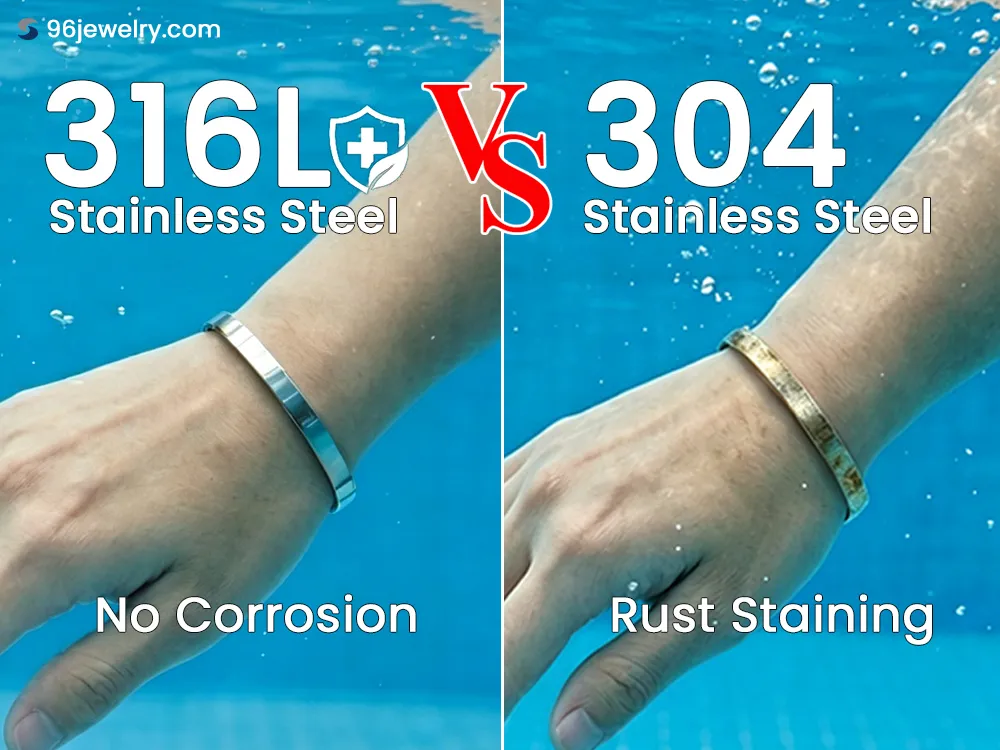
Here is the different between 316L and 304 (Common) Stainless Steel, optimized for a fashion jewelry technical manual. Why 316L? Avoid after-sales complaints with the right material choice.

| Property | 316L Surgical Stainless Steel (Jewelry Grade) | 304 Stainless Steel (Food Grade) | Significance for Jewelry |
|---|---|---|---|
| Molybdenum (Mo) | Contains 2.0% — 3.0% Mo | None (0%) | The Core Difference: Mo provides superior resistance to “pitting” caused by chlorides (salt and sweat). |
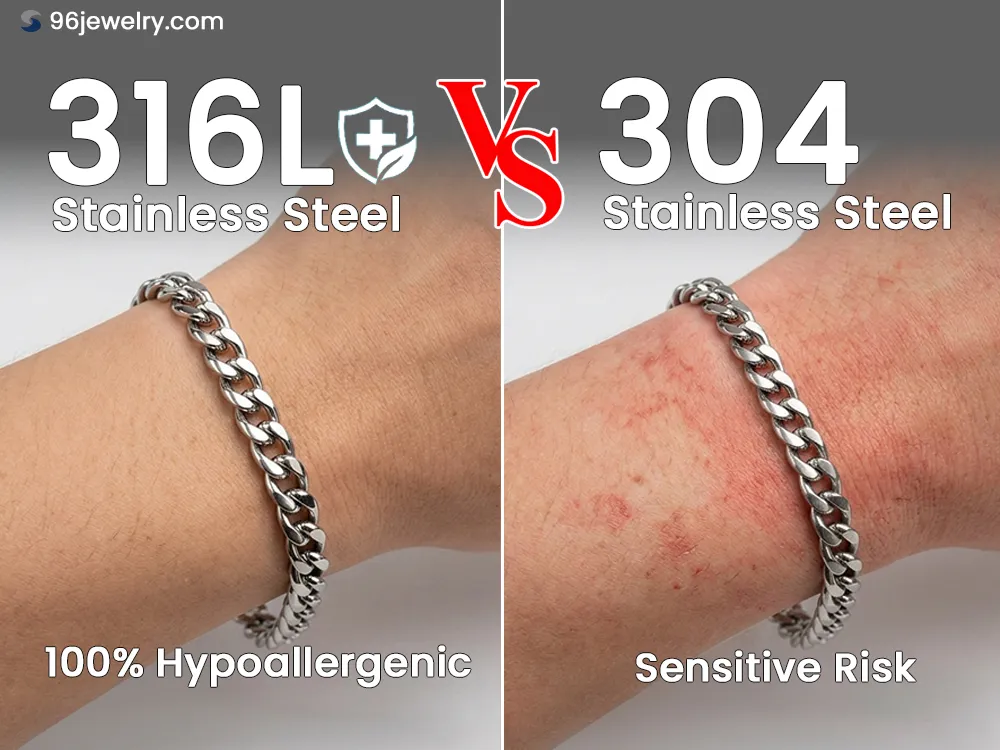
| Sweat Resistance | Excellent; Highly resistant to chloride corrosion. | Moderate; may dull or develop spots after prolonged salt exposure. | No fading or rusting even during intense exercise, swimming, or showering. |
| Skin Compatibility | Ultra-Low Nickel Release (Low Carbon) | Higher nickel release risk; may cause irritation for sensitive skin. | Hypoallergenic: Safe for 24/7 wear and sensitive skin; will not cause redness or itching. |
| Durability | Maintains luster for 5-10+ years. | May show signs of oxidation or “tea staining” after 1-2 years. | Long-term Value: Enhances brand reputation for durability and reduces after-sales complaints. |
| Visual Luster | Cool white-steel tone with a “Platinum” feel. | Slightly yellowish/greyish; lower polish depth. | Deep mirror-polish finish that mimics the look of White Gold or Platinum. |
Looking for genuine tarnish-proof inventory? Discover our full range of 316L stainless steel jewelry engineered to survive saltwater and daily wear.
Why is Molybdenum Crucial for 316L Stainless Steel Jewelry
Human sweat is naturally salty, which can damage standard 304 steel. The Molybdenum in 316L prevents this in two ways:
- It acts as a shield: Molybdenum enhances resistance to localized pitting in chloride environments by stabilizing the passive oxide layer.
- It protects the plating: It stops rust from “bubbling” under gold plating, helping PVD layers adhere tighter and last up to 30% longer than on 304 bases.
Choosing 316L over 304 is about more than just metallurgy—it’s about the silent promise you make to your customers. In an era of “fast fashion,” providing jewelry that maintains its soul through gym sessions, summer travels, and daily life is the most authentic way to build lasting brand loyalty.
Stainless Steel Jewelry Manufacturing Process Requirements
The texture of fashion jewelry stems from the ultimate treatment of the substrate. We utilize multi-stage mechanical polishing and automated grinding processes to ensure the surface achieves a “Super Mirror” finish.
- Surface Roughness (Ra): Our standard control is Ra ≤ 0.05 μm. For ultra-high-end orders, measured values can reach 0.02μm.
- Technical Significance: An ultra-low Ra value eliminates microscopic pinholes, allowing the subsequent PVD (Physical Vapor Deposition) layer to achieve perfect reflectivity. This prevents “orange peel” textures or light distortion (stray light).
- Equipment Support: High-precision 2-axis polishing machines combined with skilled manual labor, utilizing Japanese-imported grinding pastes and 3M specialized polishing consumables.
Surface Treatment (Finishing & Hypoallergenic Technology)
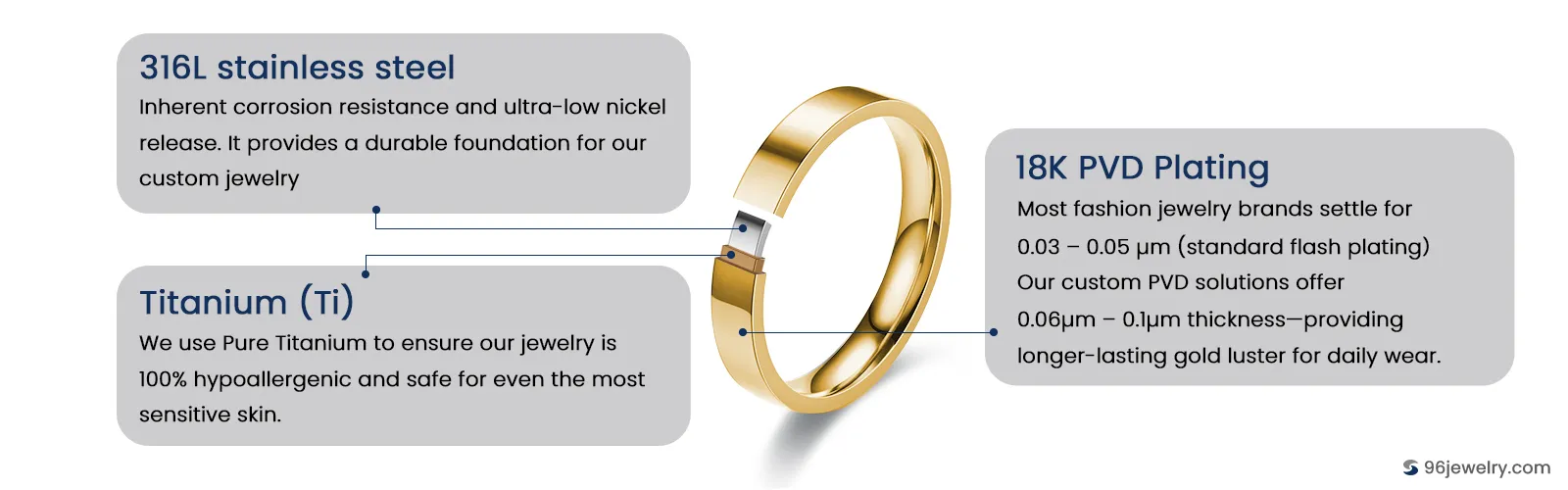
To ensure maximum safety for daily wear, we employ Physical Vapor Deposition (PVD) and Ion Plating (IP) technologies.
1. Nickel-Free Process:
- Substrate: We use 316L medical-grade stainless steel, which inherently possesses ultra-low nickel release characteristics.
- Plating Stage: The use of Nickel as an intermediate plating layer is strictly prohibited. We utilize Titanium (Ti) as the base primer to help ensure full compliance with EN 1811 nickel-free release standards.
2. PVD Plating Thickness:
- Standard Decorative Coating: 0.03 μm
- Premium Wear-Resistant Coating (e.g. IP Gold): Can reach 0.06 – 0.1μm, ensuring color durability and retention for over 2 years under normal daily wear conditions.
To learn more about how we achieve long-lasting gold color on steel, read our detailed guide on Stainless Steel Jewelry PVD Plating Technology.
International Compliance & Certification
As a professional manufacturer of 316L stainless steel jewelry exporting to European and American markets, our materials and finished products comply with the world’s highest chemical safety regulations
All compliance documentation is available for verification. View our 316L Stainless Steel Compliance Reports here.
| Certification | Target Market | Core Regulatory Requirements | Verification Status |
|---|---|---|---|
| EU REACH | Europe / EU | Annex XVII restrictions on Lead, Cadmium, and Nickel release. | 100% Compliant |
| EU RoHS | Global / Electronic Jewelry | Limits on Lead, Mercury, Cadmium, Hexavalent Chromium, etc. | 100% Compliant |
| CA Prop 65 | USA (California) | Strict limits on Lead (Pb) and Cadmium (Cd) to ensure no carcinogenic risk. | Pass / Certified |
| ASTM F2999 | USA / General | Standard Consumer Safety Specification for Adult Jewelry (Physical & Chemical). | Meets Standards |
Request our latest compliance reports or discuss your target market requirements with our team today. Our services cover everything from free design consultations to DDP/DDU door-to-door shipping with full customs clearance. Haosen guarantee a 24-hour response time for all inquiriesHaosen provide immediate solutions for any issues.
316L Surgical Stainless Steel Technical Data (Fashion Jewelry Grade)
1.Chemical Composition
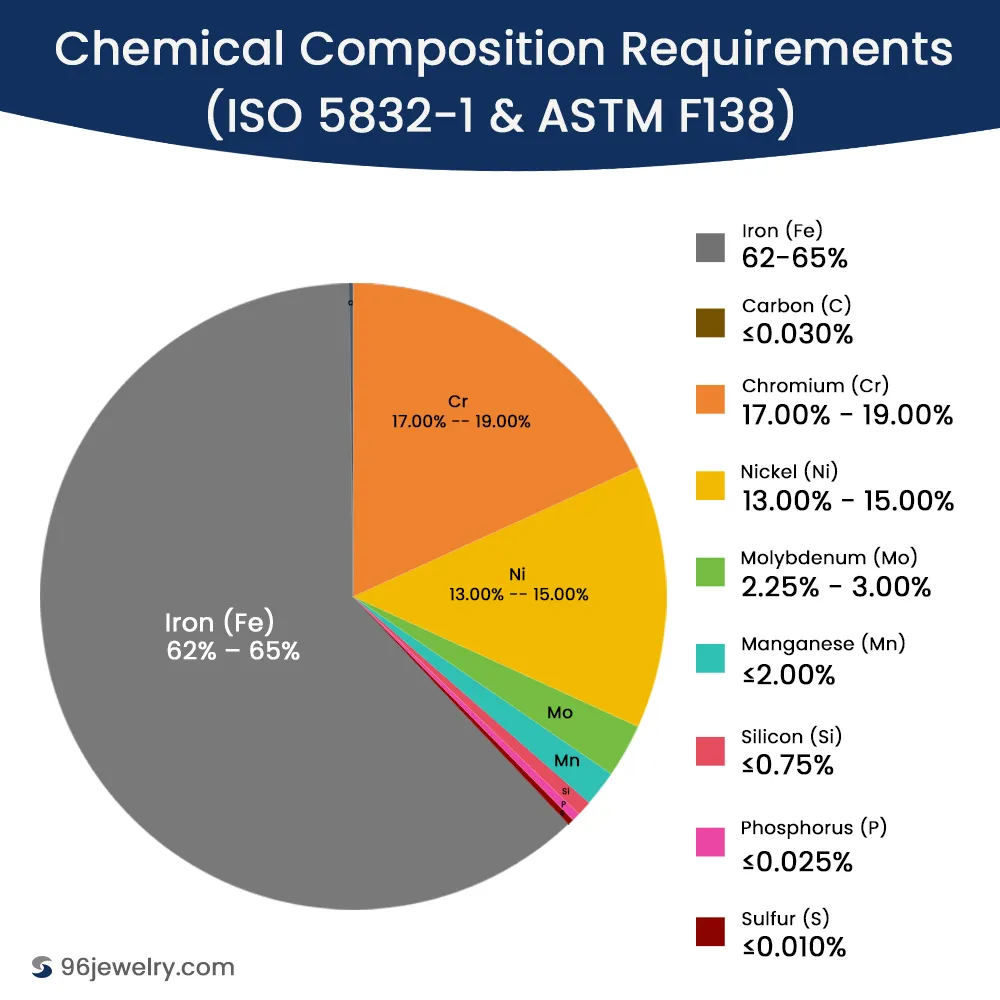
This grade strictly follows the “Low Carbon” (316L) and “Surgical Grade” requirements to ensure maximum corrosion resistance and skin safety.
| Element | Standard Range (ISO 5832-1 / ASTM F138) | Measured Value | Test Method | Data Source | Official Link |
|---|---|---|---|---|---|
| Carbon (C) | ≤0.030% | 0.021% | Infrared Combustion | ASTM International | View ASTM F138 |
| Chromium (Cr) | 17.00% — 19.00% | 17.25% | OES Spectrometer | ISO | View ISO 5832-1 |
| Nickel (Ni) | 13.00% — 15.00% | 13.48% | OES Spectrometer | ISO | View ISO 5832-1 |
| Molybdenum (Mo) | 2.25% — 3.00% | 2.31% | OES Spectrometer | ASTM International | View ASTM F138 |
| Manganese (Mn) | ≤2.00% | 1.42% | OES Spectrometer | ASTM International | View ASTM A276 |
| Silicon (Si) | ≤0.75% | 0.52% | OES Spectrometer | ASTM International | View ASTM F138 |
| Phosphorus (P) | ≤0.025% | 0.018% | OES Spectrometer | ISO | View ISO 5832-1 |
| Sulfur (S) | ≤0.010% | 0.003% | OES Spectrometer | ISO | View ISO 5832-1 |
2. Mechanical Properties & Surface Grade
Surface quality is the most critical factor for stainless steel jewelry yield rates. The “Mirror” grade ensures a flawless PVD coating and minimal polishing loss.
| Project | Standard Requirement | Measured Value (Example) | Test Method / Equipment | Data Source | Official Link |
|---|---|---|---|---|---|
| Surface Grade | Mirror (No.8) | Super Mirror | Visual / Roughness Meter | Industry Standard | — |
| Surface Roughness (Ra) | 0.05μm | 0.025μm | Roughness Tester | ISO 23160 | View ISO 23160 |
| Tensile Strength | 490 MPa | 545 MPa | Universal Testing Machine | ISO | View ISO 5832-1 |
| Yield Strength | 190 MPa | 235 MPa | Universal Testing Machine | ASTM International | View ASTM F138 |
| Elongation | 40% | 48% | Universal Testing Machine | ASTM International | View ASTM F138 |
| Hardness (HRB) | ≤95 HRB | 83 HRB | Rockwell Hardness Tester | ASTM International | View ASTM A276 |
3. Specialized Testing (Compliance & Reliability)
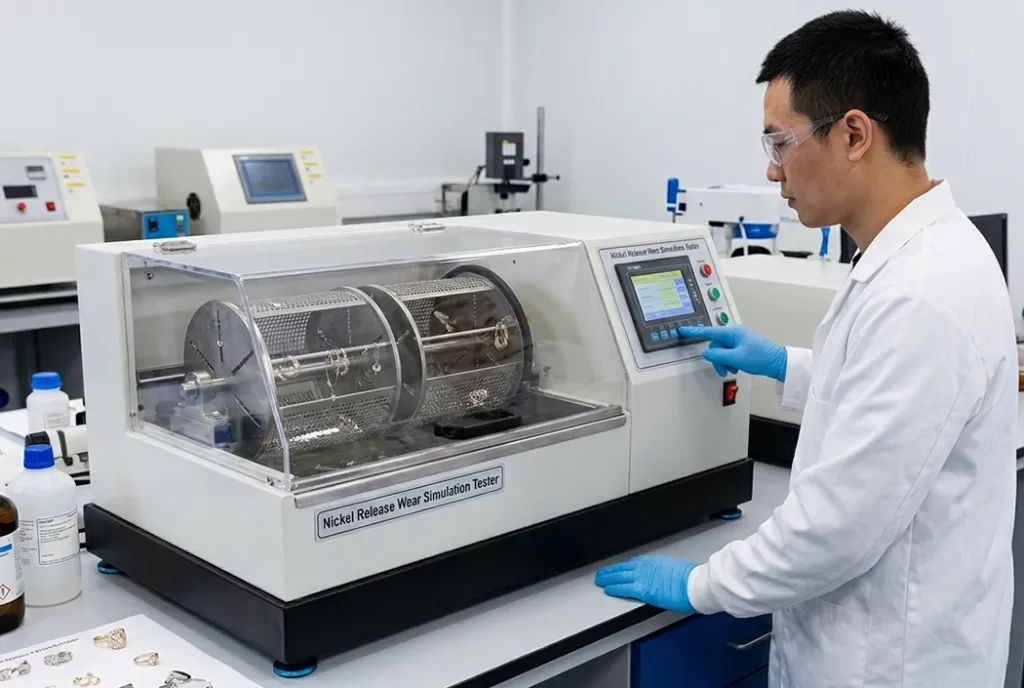
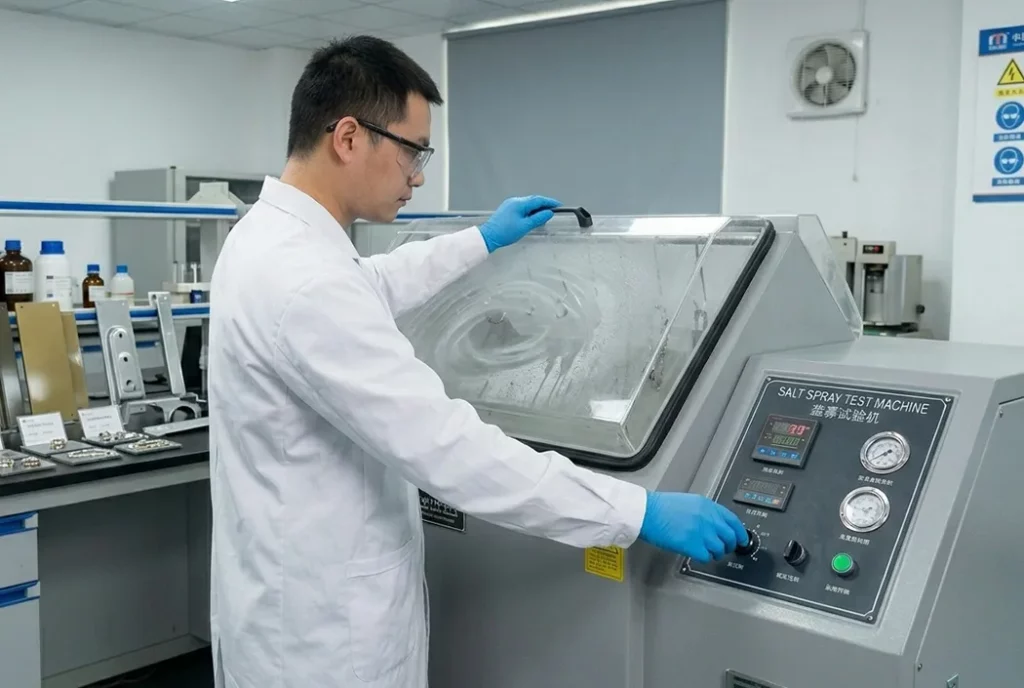
These tests guarantee that the product is “hypoallergenic” and resistant to human sweat and environmental corrosion.
| Test Item | Reference Standard | Required Value | Measured Value | Testing Equipment | Official Link |
|---|---|---|---|---|---|
| Nickel Release Rate | EN 1811:2015 | < 0.5 μg/cm2/week | 0.01 μg/cm2/week | ICP-OES | View EN 1811 |
| Prueba de niebla salina | ASTM B117 | ≥ 72 Hours (No Rust) | 120 Hours (Pass) | Salt Spray Fog Chamber | View ASTM B117 |
| Intergranular Corrosion | ASTM A262 Practice E | No Cracks after 180° Bend | Pass | Muffle Furnace + Metallographic Microscope | View ASTM A262 |
| Wear Resistance | ISO 23160:2011 | Reference for PVD/Mirror | No visible scratches | Abrasion Tester | View ISO 23160 |
Preguntas frecuentes
Q1: Why is 316L called “Surgical Steel”?
A: 为什么316L被称为“医用钢”?答:这是美国用来描述其高纯度和耐腐蚀性的术语。由于它足够安全,可以用于外科器械和医疗植入物,不会引起人体反应,因此是时尚首饰的最佳选择,尤其适合耳部敏感的人群。
Q2: Why is 316L stainless steel considered the best corrosion-resistant material?
A: 316L stainless steel is considered the superior choice for jewelry because it contains molybdenum, an element that significantly boosts its resistance to chlorides and corrosive environments, such as sweat or saltwater. This combination of chemical stability and extreme durability makes it the industry standard for long-lasting, tarnish-free, and skin-safe accessories.
Q3: Will 316L stainless steel jewelry turn my skin green?
A:Not at all. That “green finger” effect is usually caused by copper or brass reacting with skin oils. 316L is chemically stable and doesn’t oxidize in a way that discolors your skin. It’s one of the most reliable choices for a “clean wear” experience.
Q4: Why does some “316L” jewelry from other suppliers still rust?
A: Usually, it’s one of two things:
The Mix: Some suppliers use “recycled scrap” or 304 grade, which lacks the Molybdenum needed to fight corrosion.
Cross-Contamination: If a factory uses the same tools for carbon steel and stainless steel, tiny iron particles can get “stuck” on the surface. Those particles rust, not the jewelry itself. This is why we maintain dedicated, clean polishing lines.
Q5: Is it truly “Waterproof” and “Sweat-proof”?
A: Yes. Thanks to the Molybdenum, it creates a self-healing shield against salt water and sweat. We certify our pieces to pass a 120-hour Salt Spray Test, so your customers can wear them in the pool, at the gym, or in the shower without a second thought.
Q6: Why is 316L Stainless Steel More Expensive Than Zinc Alloy for Custom Jewelry?
While zinc alloy is ideal for high-volume projects due to its lower energy and molding costs, 316L stainless steel requires a 20%–50% higher investment in specialized CNC machining. However, this premium cost is offset by superior durability and hypoallergenic properties, which support higher brand markups y significantly reduce after-sales returns.
Q7: Does 316L really make gold plating last longer?
A: Yes, significantly. Unlike brass, 316L doesn’t oxidize underneath the plating. Think of it as a solid foundation. On our mirror-polished surfaces (0.025 μm), the PVD coating adheres so well that it typically lasts twice as long as it would on a standard 304 base.
Q8: If 316L contains Nickel, how can it be “Hypoallergenic”?
A: It sounds like a contradiction, but here’s the key: Under compliant manufacturing and surface finishing conditions, 316L demonstrates extremely low nickel release within EN 1811 limits.Our tests show a release rate that is 50x lower than EU safety limits. It’s the same reason the medical world trusts it for implants—it’s built to be biologically inert and skin-friendly.
Q9: Is it good for intricate or detailed designs?
A: 316L is tough, which makes it perfect for sharp, clean lines and deep engravings—styles that need to look “crisp.” For very complex 3D shapes, we use MIM (Metal Injection Molding). It’s a bit more of an investment than brass casting, but the result is a piece that won’t bend or lose its shape over time.
Q10: Can I market 316L as “Eco-Friendly”?
A: Absolutely. Stainless steel is a “Green Material” because it is 100% recyclable without losing quality. Most of our raw steel is already made from 60% recycled content. Plus, our PVD coating process is much cleaner than traditional electroplating, producing zero chemical wastewater.
Q11: How can my brand verify we are getting the “Real Deal”?
A: We provide a Material Test Report (MTR) for every batch. If you want to test it yourself, you can use a handheld XRF analyzer to check for that 2-3% Molybdenum. A simple “316 identification liquid” also works—real 316L won’t change color, while 304 will turn pink.
Q12: Is 316L better than Sterling Silver for daily wear?
A: It really depends on your brand’s goal, but for durability, 316L takes the lead. It’s much harder than silver, meaning it won’t bend or scratch as easily. Plus, it doesn’t tarnish (turn black), so your customers don’t need to polish it every week to keep it looking new.
A: 为什么316L被称为“医用钢”?答:这是美国用来描述其高纯度和耐腐蚀性的术语。由于它足够安全,可以用于外科器械和医疗植入物,不会引起人体反应,因此是时尚首饰的最佳选择,尤其适合耳部敏感的人群。
A: 316L stainless steel is considered the superior choice for jewelry because it contains molybdenum, an element that significantly boosts its resistance to chlorides and corrosive environments, such as sweat or saltwater. This combination of chemical stability and extreme durability makes it the industry standard for long-lasting, tarnish-free, and skin-safe accessories.
A:Not at all. That “green finger” effect is usually caused by copper or brass reacting with skin oils. 316L is chemically stable and doesn’t oxidize in a way that discolors your skin. It’s one of the most reliable choices for a “clean wear” experience.
A: Usually, it’s one of two things:
The Mix: Some suppliers use “recycled scrap” or 304 grade, which lacks the Molybdenum needed to fight corrosion.
Cross-Contamination: If a factory uses the same tools for carbon steel and stainless steel, tiny iron particles can get “stuck” on the surface. Those particles rust, not the jewelry itself. This is why we maintain dedicated, clean polishing lines.
A: Yes. Thanks to the Molybdenum, it creates a self-healing shield against salt water and sweat. We certify our pieces to pass a 120-hour Salt Spray Test, so your customers can wear them in the pool, at the gym, or in the shower without a second thought.
While zinc alloy is ideal for high-volume projects due to its lower energy and molding costs, 316L stainless steel requires a 20%–50% higher investment in specialized CNC machining. However, this premium cost is offset by superior durability and hypoallergenic properties, which support higher brand markups y significantly reduce after-sales returns.
A: Yes, significantly. Unlike brass, 316L doesn’t oxidize underneath the plating. Think of it as a solid foundation. On our mirror-polished surfaces (0.025 μm), the PVD coating adheres so well that it typically lasts twice as long as it would on a standard 304 base.
A: It sounds like a contradiction, but here’s the key: Under compliant manufacturing and surface finishing conditions, 316L demonstrates extremely low nickel release within EN 1811 limits.Our tests show a release rate that is 50x lower than EU safety limits. It’s the same reason the medical world trusts it for implants—it’s built to be biologically inert and skin-friendly.
A: 316L is tough, which makes it perfect for sharp, clean lines and deep engravings—styles that need to look “crisp.” For very complex 3D shapes, we use MIM (Metal Injection Molding). It’s a bit more of an investment than brass casting, but the result is a piece that won’t bend or lose its shape over time.
A: Absolutely. Stainless steel is a “Green Material” because it is 100% recyclable without losing quality. Most of our raw steel is already made from 60% recycled content. Plus, our PVD coating process is much cleaner than traditional electroplating, producing zero chemical wastewater.
A: We provide a Material Test Report (MTR) for every batch. If you want to test it yourself, you can use a handheld XRF analyzer to check for that 2-3% Molybdenum. A simple “316 identification liquid” also works—real 316L won’t change color, while 304 will turn pink.
A: It really depends on your brand’s goal, but for durability, 316L takes the lead. It’s much harder than silver, meaning it won’t bend or scratch as easily. Plus, it doesn’t tarnish (turn black), so your customers don’t need to polish it every week to keep it looking new.
Final Thoughts
High-performance jewelry isn’t just about a beautiful design; it’s about how that design holds up in the real world. By choosing 316L, you’re choosing a material that respects your customers’ skin and keeps its luster through the rhythm of daily life.
As a 316L stainless steel jewelry manufacturer, our goal is to handle the technical heavy lifting—from Molybdenum levels to mirror-finish precision—so you can focus on building your brand with confidence.
Let’s keep the conversation going. Send us your design drawings or product specifications today, and our engineering team will provide a material assessment, feasibility feedback, and a clear quotation within 24 hours.
Let’s create your custom jewelry together
Updated: May 15, 2026, at 8:00 PM (EDT)